Paper Notes: C2CServe
Citation
The paper named “C2CServe: Leveraging NVLink-C2C for Elastic Serverless LLM Serving on MIG” The work is done by people from UVA.
Motivation
LLM serving is shifting toward serverless: large model catalogs, long-tail invocations, multi-tenant demand. Production traces (Alibaba, 89 models over three weeks) show 83% of models active <20% of the time, median model idle 96% — yet they must respond quickly to unpredictable bursts.
Existing approaches both fail:
- Dedicated-GPU: model stays warm in HBM → no cold start, but wastes GPU memory under sparse traffic.
- GPU time sharing: multiplexes models on one GPU → improves utilization, but switching models requires reloading GBs of weights over PCIe → heavy cold-start latency.
MIG (Multi-Instance GPU) offers a middle ground: hardware-partition one GPU into up to seven isolated slices. But each slice has too little HBM for modern LLM weights (even a full 96 GB GH200 can’t hold a 70B model in BF16).
The opportunity. GH200/GB200 Superchips provide NVLink-C2C (~450 GB/s, ~7× PCIe). Fast enough that model weights can stay in CPU memory and be streamed on-demand to MIG slices via zero-copy — no need to preload into HBM. This decouples model residency from scarce HBM: MIG gives fine-grained compute, C2C gives abundant weight storage.
The challenge. Existing GEMM kernels assume HBM-resident operands — naïvely pointing them at CPU-resident weights causes repeated C2C fetches, saturating the shared interconnect. Worse, C2C bandwidth is shared across all MIG instances on a Superchip, so one tenant’s weight streaming degrades another’s. C2CServe asks: how to make MIG practical for serverless LLM serving under the shared C2C bottleneck?
Key Ideas
C2CServe has three key ideas:
① MIG + C2C for serverless LLM serving. MIG provides fine-grained, hardware-isolated GPU slices for multi-tenant serving. C2C (~450 GB/s) extends each slice beyond its private HBM to a shared CPU-memory weight store. Model weights stay in CPU memory and are streamed on demand — no preloading, no HBM residency. Cold starts become cheap: just initialize runtime state, no weight transfer.
② HybridGEMM: adaptive GEMM for heterogeneous memory. Existing GEMM kernels (cuBLAS, CUTLASS) assume HBM-resident operands and use a single fixed dataflow. C2CServe instead uses two complementary GEMM strategies running on different SMs of the same MIG instance:
- SymGEMM (output-stationary): streams both X and W, writes partial O to HBM — stresses C2C but preserves GEMM efficiency.
- AsymGEMM (weight-stationary): keeps W in SMEM/L2 and reuses it across input tiles, accumulates O in HBM — reduces C2C traffic at the cost of extra HBM traffic.
A single knob α (the fraction of SMs assigned to SymGEMM) trades C2C traffic for HBM traffic per MIG slice, matching the current HBM/C2C bandwidth balance. The two paths write disjoint output columns so no synchronization is needed.
③ Hierarchical scheduling with feedback control. C2C bandwidth is shared across MIG instances. The scheduler coordinates three decisions: model placement (avoid co-locating large models on the same GPU), input chunk size (larger chunks → more weight reuse → less C2C pressure), and the HybridGEMM knob α. A feedback controller monitors TPOT/TTFT at runtime and adjusts α and chunk size to maintain SLOs under contention.
GEMM Shape Matters
For O(M,N) = X(M,K) × W(K,N) where X is in HBM and W is in CPU memory, M and N have opposite effects:
- Larger M (more tokens per chunk): each fetched weight tile is reused more times → better C2C amortization → higher efficiency.
- Larger N (hidden dimension): forces more weights to be fetched per tile → higher C2C pressure → C2C-bound.
This means chunk size and model size directly determine the bottleneck, which guides the scheduler’s decisions.
Cross-Instance C2C Contention
Experiments show the interference gap (solo-run vs. co-run throughput) widens from 28% to 42% as total colocated model size grows from 5 GB to 44 GB. Larger parameter footprints mean more concurrent C2C fetches from different MIG instances, saturating the shared link. The scheduler uses model footprint as a signal to avoid co-locating heavy models.
How It Works
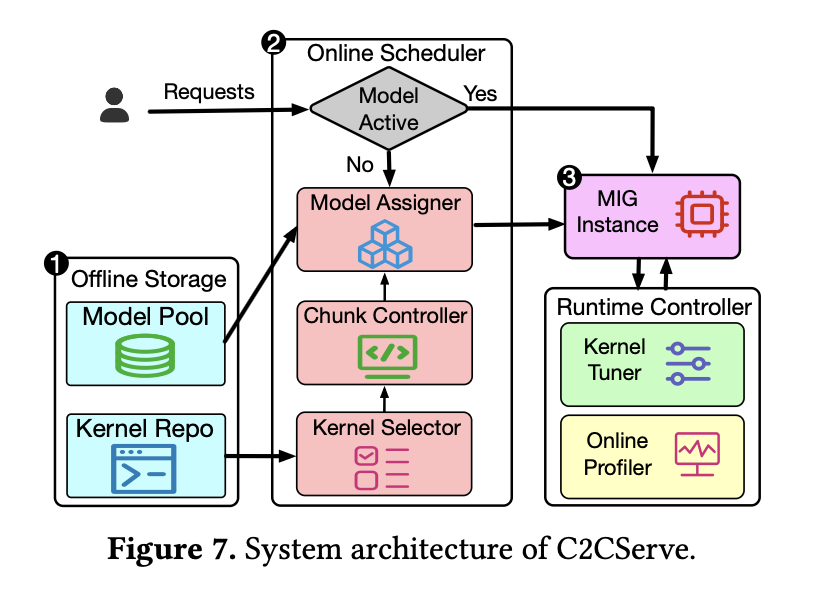
C2CServe has three runtime components:
① Offline Kernel Builder. Pre-compiles HybridGEMM variants for different precision × shape × MIG partition combinations. Each variant exposes the α knob. At initialization, α starts at 0 (all AsymGEMM, C2C-frugal).
② Online Scheduler. On each request, four steps:
- If the model is already active on a MIG instance, route directly (no setup).
- Else, pick an idle MIG instance — or evict a low-priority model if none is free. Placement respects a C2C budget: Σ BW_C2C(m) ≤ BW_avail, where BW_C2C(m) = S_m / TPOT_target.
- Select chunk size from an offline profiling table. Larger chunks → better GPU utilization but more C2C pressure. The constraint: estimated HBM demand must stay within the MIG slice’s HBM bandwidth.
- Select initial α from the profiling table.
③ Runtime Controller. A feedback loop monitors latency, HBM utilization, and C2C utilization (smoothed via EMA). The tuning rule: if C2C utilization exceeds HBM utilization by more than threshold τ, decrease α (favor AsymGEMM to reduce C2C pressure). If HBM is more saturated, increase α (favor SymGEMM). This keeps TTFT/TPOT within SLO under dynamic multi-tenant contention.
Experiments & Results
Setup. GH200 Superchip (480 GB CPU, 96 GB HBM3, C2C ~900 GB/s), CUDA 12.8, PyTorch 2.7, built on mini-sglang. Models: Llama-3 (3B/8B/70B), Mixtral-8x7B, Qwen3-30B-A3B (BF16). Workload: Alibaba GenTD26 production trace (3.5M requests, 87 models, 3 weeks). Baselines: ServerlessLLM, Aegaeon (dense); MoE-Infinity, FineMoE (MoE). Metrics: p95 TTFT/TPOT, cold-start latency, model-switch latency.
Full-GPU serving (Fig. 9). C2CServe matches or beats baselines on dense models and enables Llama-70B where ServerlessLLM and Aegaeon OOM. On MoE, TTFT improved 3.0–7.2× over baselines; TPOT competitive.
Cold-start latency (Fig. 10). C2CServe reduces cold-start by up to 7.1× on dense models (vs. Aegaeon) and 4.6–5.0× on MoE (vs. MoE-Infinity/FineMoE). Also enables Llama-70B cold starts where others OOM.
Model-switch latency (Fig. 11). Under MIG, C2CServe switches in 50 ms (dense) / 318 ms (MoE), vs. 1.7 s / 12 s for ServerlessLLM — one to three orders of magnitude faster. Weights stay in pinned CPU memory; only runtime state is reinitialized.
Dynamic workload (Fig. 12). Under bursty trace replay, C2CServe keeps TTFT at 0.2–0.7 s (dense) and 0.5–0.8 s (MoE), meeting a 1 s SLO for 95% of requests. Baselines frequently spike to 2–10 s.
Ablations (Fig. 13, 14):
- HybridGEMM alone in existing systems: reduces TTFT 36–68%, enables Llama-70B on ServerlessLLM.
- Bandwidth-aware placement vs. random: 1.94× p99 TTFT reduction (1.24 s → 0.64 s).
- Chunk-size control vs. default: 2.83× p99 TTFT reduction (1.81 s → 0.64 s). Smoothes C2C burst pressure during prefill.
- HybridGEMM α tuning vs. static: 1.48× p99 TTFT reduction (0.95 s → 0.64 s). Static α overloads either C2C or HBM; runtime tuning balances both.
Future hardware projection (Table 2). C2CServe benefits from Superchip roadmap: Rubin’s 3.2× CPU memory and 2× C2C bandwidth expand the CPU-resident model pool, offsetting the relative GEMM gap vs. HBM-resident execution.
Fundamental Underlying Technologies
Serverless
Serverless is a cloud execution model where the cloud provider dynamically manages resource allocation. Users deploy functions without provisioning or managing servers — the platform automatically scales resources up on demand and scales down to zero when idle. Key properties: fine-grained billing (pay per invocation, not per uptime), auto-scaling (elastic response to load spikes), and cold starts (latency penalty when an idle function is invoked, as the runtime must be initialized).
In the LLM serving context, serverless maps naturally to long-tail model catalogs: most models sit idle most of the time, but must respond quickly to bursty requests. The cold-start problem for LLMs is particularly severe because “initialization” means loading gigabytes of model weights and constructing CUDA graphs — far heavier than a typical container startup.
C2C
NVLink-C2C, Chip to Chip,封装内芯粒互联(MCM 多芯片模块),GPU/CPU 裸片封装在同一个芯片外壳里,毫米级短距离走线。
Input
Input 是用户实时推理数据(一句话、一张图),流程是:用户请求 → CPU 简单预处理 → 直接下发存入 GPU 本地 HBM。
Symmetric GEMM and Asymmetric GEMM
Symmetric 对称的含义:系统对输入矩阵X和权重矩阵W一视同仁,平衡两者的搬运、读取开销,不会刻意固定其中一个数据不动。计算时会交替搬运X和W到 GPU 计算单元,两者访问频次、数据搬运量基本对半分。Asymmetric GEMM 非对称数据流矩阵乘,固定权重矩阵 W 驻留在 GPU 片上缓存,全程不重复加载;只持续流式传入输入 X、流式写出累加输出 O,两个矩阵访存策略完全不对称。